Monday, October 11, 2010

What makes a good blog?

こちらはわたしのにほんごのがくせいのブログのrecommendationsです:

とうきょう マンゴ はおもしろいのブログです。I would like to recommend it to people who want a quick, fun, にほんのcultureのブログ。But, do be warned that sometimes the content is NSFW or more "adultish" than some other sites.

JustBento and JustHungry are my favored sites for にほんごのりょり, especially for people who don't have much experience with cooking but are curious about おべんと or all sorts of にほんごのたべもの。まきこさんときどきにほんごでかきます(although the primary language is English)。She is wonderful in her adaptations of recipes, sometimes doing different versions (aside from language) for Japan and other parts of the world due to the availability of cooking equipment and/or ingredients. Do be warned right now that she is exploring diabetic friendly food on Just Hungry, so you might find some of the archives more interesting than the content right now.  But I must say I found her apocryphal (in what I think is a good way) こんにゃく aglio olie e peperoncino recipe quite interesting.  Overall, she not only provides many of the basics of Japanese cooking but also covers media coverage of Japanese food (and culture) as well as some Japanese food (and culture) trends.

I will recommend some other resources later, but these will have to do for now.  These sites combine English and Japanese, which is great for にほんごのいちねんせい。Tell me what you think of these sites or recommend ones that you like.

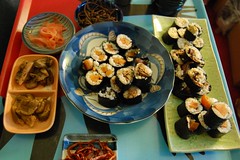
And I will throw in a cute, autumnal picture for good measure, as that just might make this a better post!

DSC_0963
ポーテルはわたしとニューヨークのハリマンにわへいきました。

Saturday, October 9, 2010

うちににほんごではなしますか?

こんしゅうはむずかしです。 I don't mean this in a bad way, but I am definitely facing some challenges with the languages this week (although it may just be a matter of perspective).  I feel like this week I have made a few unnecessary errors on my quizzes in both にほんごのクラス or ちゅうごくのクラス, in that I know that I know these things but made careless mistakes.  A point or two on a couple quizzes is also not monumental in magnitude, it is unlikely to determine my grade in the classes nor (and more importantly) will it determine my knowledge of Japanese or Chinese.  And I did just fine on my tests in these classes.  But that's not what I want to focus on here.  I am taking two intense language courses, how will I try to keep on track?

More importantly, it made me realize that I need to "利用一切机会说日文" (that's ちゅうごくご for "use every opportunity to speak Japanese").  It is something I heard all summer long at the Columbia in Beijing Program, if you replace 日文 with 中文.  My ちゅうごくごのせんせい told us this almost every day, and had us repeat it almost every day.

Yet here I am, living with another にほんごのがくせい。  Why shouldn't I practice with him more (aside from the fact that we are both だいがくいんせ so we don't see each other much げつようびからもくようびまで)?  かれは  ニューヨークのにほんの協会 に  にほんごを べんきょうします (NB I am not sure if that's how one would translate "Japan Society", but to my surprise they don't seem to have a Japanese website).  Although I do have some experience with some more complex and more informal things in Japanese, I think we are finally hitting material that I can practice effectively at home.  For example, schedule related material is something that, being married, we have to communicate all the time.  I do realize that married people would not speak as formally as what we are learning now, but that's ok.  I need to remember to put this into practice.  There is one circumstance, where I have already habituated to communicating in Japanese: when I check my email at スターのとしょかん, I use the pre-installed にほんごのkeyboard to chat with him.  The funniest part of that is that my one day visit to とうきょう influenced this habit, as I forced him to read hiragana when I had trouble with the にほんのkeyboard at the りょかん I stayed at.

(P.S. I promise to include some pictures or media or something in the future!)

Monday, October 4, 2010

some thoughts

First, ごめなさい!Somehow between this, that, and the other (ここ、そこ、あそこ. Yes, I am throwing those in for practice but I also realize you can't directly translate aphorisms) I have neglected to post to this blog.  I think it was a combination of confusion as to content and a bit of unexpected class time.  Well that and me completely forgetting for a bit.

So, without trying to pretend that I am writing this in the past, I will try to write about my weekend in Japanese.


せんしゅうのきんようびのごごよんじに わたしは コロンビアだいがくのEALACのdepartmentのだいがくいんせの"happy hour"に いきました。ペンさんも いきました。

きんようびのごご わたしはおっととわたしたちのいぬと じどうしで Fishkill Farmへ いきました。りんごを pickingしました。おいしいです!

わたしとおっとは わたしたちのともだちのにゅうじのChristeningに きのうごごにじばんからはちじまで いきました。[Should this be a different verb, like "to attend"?  I am not sure I can say to go to an event like this.]

わたしは きょうごぜんななじばん ちかてつで がっこうへ いきました。にほんごとちゅうごくごのtestをしました。はい、にtestをしました。


I think that is all for now! Maybe next time I will do more than just practice grammar!

Thursday, September 16, 2010

Why Japanese language class?

      I love learning languages (am a bit of an addict) and I find studying Asian languages especially exciting.  After studying Spanish and French in high school, I started taking Chinese in college wanting to experience learning a non-Indo-European language.  Just as I felt an obligation to learn Spanish due to its importance and utility, I felt that studying Mandarin made sense as a language to start with for East Asia.  Yet I have grown up with interest in and exposure to Japanese culture and have developed a correlating interest in Japanese language study.  So, learning Japanese has always been on my life agenda.  I have already studied a bit of Japanese, but have chosen to take class at Columbia now for a couple of reasons--including the conclusion that my basic language skills did not seem likely to improve without more frequent and formal class work.  I am already remembering and reinforcing my previous exposure, even after only seven classes (whose time was also spent on orientation and entrance exams), I can already notice a big difference.  It will be so much easier to learn Japanese attending class four days a week versus once a week.

     Somewhat purposefully, I am taking Japanese now so as to get accustomed to thinking/living/learning Chinese and Japanese concurrently.  I realize that trying to tackle both at once may be seen as a potential hindrance, but I believe there may be benefits.  I have already experienced learning two languages at once, French and Spanish.  By studying them at the same time, I had to adapt to keeping them separated both in and out of class.  This is excellent practice for those real world situations where one is forced to switch between languages.  For example, I was in Tokyo for just one day a few weeks ago.  While there I spoke both French and Spanish with people as well as English and my rudimentary Japanese.  Well, actually I spoke some Chinese to them too, but not on purpose!  It was both fun to communicate in multiple languages as well as practical.  Though my native English is currently the lingua franca of the world, not everyone learns English and not everyone chooses to pursue English as their best foreign language.
     Another point I'd like to mention is that I am interested in the relationship between kanji and hanzi (written 漢字 or 汉字 depending on where you are from), and how the characters will play into my learning Japanese.  I have reached the point of Chinese character recognition where I can "understand" many of them in a reference book for English-speaking students of Japanese kanji.  But (and this is a big caveat) I read the characters as though they were Chinese!  So when I encounter Japanese sentences with kanji my natural instinct is to insert Chinese in the middle of a Japanese phrase.  Even though the way I approach kanji will undoubtedly be influenced by my study of Mandarin, I don't think it will completely replicate the way that a native Chinese speaker would be.  It is nice, however, having already adapted to the idea and practice of recognizing unique characters which are not Roman letters.  I am not particularly looking forward to writing out more kanji handwriting practice (not my favorite, done it in previous Japanese and Chinese classes). This is not to say I have great handwriting!  Sore writing hand aside, I find the history of languages and linguistics quite intriguing (I've also studied some Historical and Anthropological Linguistics).  I hope to have a few interesting discussions about these sorts ideas with other students who confront active engagement with English, Japanese, and Chinese (regardless of their backgrounds).  I am also interested in the pedagogical methods in teaching kanji (as well as the overarching approach to teaching Japanese at Columbia), will they (it) be different than my previous experience?


There are other reasons for me to learn Japanese as well--academically, professionally, and personally, yet I would like to save some of them for another post.  Until then!


はじめまして!

わたしは エリズ。コロンビアだいがくいんのいちねんせいです。アメリカじんです。アメリカのチカゴから きました。よろしくおねがいします。
 

Blog Template by YummyLolly.com